
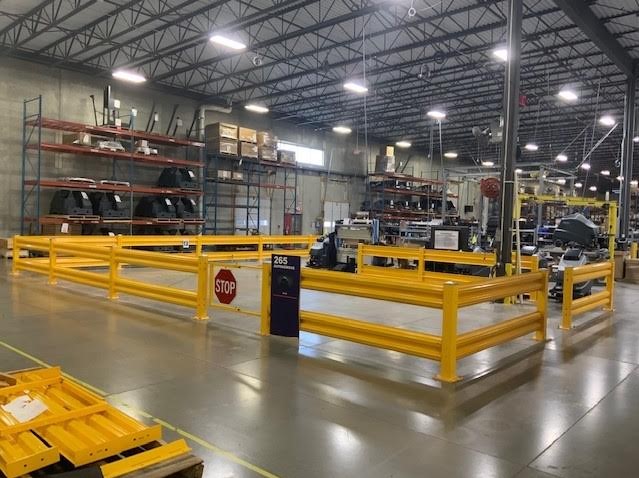
It is easy to assume that installing a warehouse guardrail automatically “solves” warehouse safety. Many facilities feel that sense of relief right after installation. The floor looks organized. The lanes look defined. The risk feels handled.
But this is where a quiet misconception begins. Accidents can still happen when guardrails provide coverage, but the layout itself lacks control. The barrier is present, yet movement still follows the same risky paths as before. So what is actually missing when protection exists, but incidents continue? Most importantly, why do warehouse safety guardrails sometimes fail to change outcomes on the floor?
The sections below break down the most common reasons accidents persist, even in warehouses that appear well-protected at first glance.
1) Guardrails exist, but they do not match real movement
Most warehouse layouts have two versions.
One is the “planned” version on paper. The other is the real one created by daily shortcuts, rush cycles, and staging pressure.
When a warehouse guardrail is placed based on drawings, it may miss the true contact zones. Those zones are usually the tight turns, the drift-prone aisles, and the edges people “hug” when equipment passes. Here, the barrier is not the problem. It may, in fact, be the best safety system you have, but the problem is that it is protecting the wrong line.
What to watch for on your floor:
- Forklifts routinely cut corners near the barrier line
- Pedestrians walking outside marked paths because it is faster
- Pallets temporarily parked where a turning space was “assumed” to exist
If these things are happening in your warehouse, then this is not an issue caused by warehouse safety guardrails. Instead, it is caused by a movement mapping issue.
2) The layout forces people and forklifts to make decisions in the same spot
A major reason industrial warehouse barriers fail to prevent incidents is placement around decision zones. These are the areas where forklift operators already have too much to manage.
Think of turning radius, load swing, clearance, and visibility. Now add pedestrians crossing in that exact moment. Risks are bound to increase fast. If a layout repeatedly creates these overlaps, even strong warehouse safety guardrails get pushed into a reactive role.
Here is a safer approach:
- Keep crossings out of turning paths.
- Funnel pedestrians to straight-path crossing points.
- Use barriers to prevent “corner cutting” on both sides.
3) “Staging area increases, quietly destroying the space your layout depended on.
Many accidents do not begin with a reckless act. They begin with a slow layout change that becomes normal.
A pallet sits in a turn zone “for now.” Then another one follows. Soon, forklifts have less room to correct. Hence, drivers compensate by drifting wider or braking late.
At that stage, your warehouse guardrail takes more knocks and physical contact. This is not happening because drivers have gotten worse, but because the environment has gotten tighter. At this point, separation and traffic control matter a lot. Your priority should be to clear out the staging area. Once you do, it is strategic to use industrial warehouse barriers to define staging limits. Doing this would prevent staging creeps in the future.
4) One barrier style gets used everywhere, so risk looks “flat”
Not every route carries the same risk. Still, many facilities apply the same barrier height and spacing across every aisle. The intent is consistency, but the outcome can be confusion.
When everything looks equally “protected,” operators rely on habit instead of awareness. Here, high-risk corridors do not feel different from low-risk paths. This is where warehouse safety guardrails should do more than block. They should communicate the hierarchy.
Here are practical hierarchy recommendations:
- Stronger, continuous protection on primary forklift routes
- Lighter separation on pedestrian-only paths
- Intentional openings only at controlled crossings
5) The barrier is installed, but it is no longer performing like one
A barrier can exist and still fail functionally.
- Anchors loosen over time.
- Posts shift after repeated low-speed contact.
- Rails bend and never fully return.
At that point, the warehouse guardrail may still look “present,” but it is no longer guiding movement. It is only waiting for the next hit. This is where maintenance discipline matters. Not because you want perfection. Because small degradation changes how impact energy transfers on the next contact.
Here are things you should notice that point to early signs of wear and tear:
- Base plates no longer sit flush
- Posts leaning slightly off line
- Rails are showing uneven deformation in the same locations
Here is a quick self-audit: 6 questions that reveal hidden risk
Use these questions during a floor walk:
- Where do forklifts brake late or correct suddenly?
- Where do pedestrians cross because it saves time?
- Where does staging repeatedly spill into travel space?
- Which intersections have obstructed sightlines?
- Which barriers show repeat contact in the same spots?
- Which lanes look “protected” but still feel chaotic?
If you find patterns, you have found your real risk map.
Conclusion
A warehouse guardrail rarely fails because steel is weak. It usually fails because the layout asked it to do too much, too late, in the wrong place. Strong protection starts earlier than installation. It starts with designing movement that stays predictable under pressure.
When warehouse safety guardrails are placed around real behavior, they stop being decorative and start restoring control. Check out the strongest safety barriers backed with 12 12-month guarantee at Guardrail Online. We are here to help secure warehouses against all scales of accidents. Explore our range of safety barriers today!